Chisinau (Moldova) & Transnistria

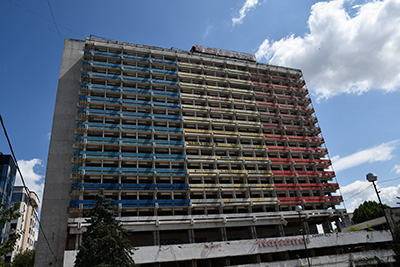
Our appartment was located on the 7th floor of this building

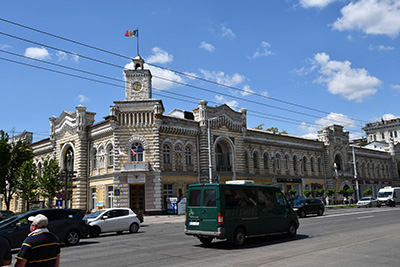
Chișinău is often labelled as Europe’s least-visited capital. For us, that sounded less like a warning and more like an invitation. After all, not every trip has to be to an everyday tourist hotspot.

So, under the motto “Why follow the crowds when you can avoid them?”, we booked our tickets with LOT Polish Airlines and set off for Moldova. A smooth connection through Warsaw brought us to Chișinău in no time.

Our Airbnb turned out to be an absolute gem, making it the perfect base for a week of exploring. Soon we were wandering through leafy parks, broad boulevards and lively squares, discovering a city that many travellers skip without giving it a second thought. Their loss, really. Chișinău may not shout for attention, but it quietly wins you over—and sometimes those are the destinations that leave the strongest memories.

It all started a very long time ago, probably in the early 1980s, when Egbert found himself standing on the West German side of the former East German border crossing at Schlutup, in northern Germany. What exactly sparked his fascination with borders and hard-to-reach places is anyone’s guess. But over the years, his passport gradually filled with visas from many of the former Eastern Bloc countries, including the then still existing GDR and Czechoslovakia. The red tape and bureaucracy never discouraged him—they simply became part of the adventure.

Last year, while travelling through Georgia, his eyes lit up as we approached the border with South Ossetia. We didn’t cross it, but the attraction of places that exist in a political grey zone was clearly still there. So when we decided to spend a week in Moldova, he came up with the inevitable question “Shall we visit Transnistria?” Official travel advice from many governments strongly discourages all but essential travel to the region because of its unresolved political situation, limited consular assistance, and the unpredictable security environment. We were fully aware of those warnings before deciding to join an organised day trip.

Notice from diplomatie.belgium.be:
All travel to Transnistria is strongly advised against, including transit through Transnistria from Moldova to Ukraine. In Transnistria, a region seeking secession, safety cannot be guaranteed as the Moldovan authorities have no control over the area. There are no fixed rules governing border crossings, which on some days proceed without difficulty but on others are extremely cumbersome. It is possible that, should problems arise in Transnistria, travellers will be left to fend for themselves. Consular assistance cannot be guaranteed there.

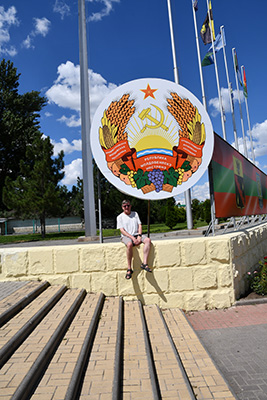
Come along with us as we visit a country that officially doesn’t exist. Transnistria is an unrecognised breakaway state, acknowledged only by the similarly unrecognised entities of South Ossetia and Abkhazia. Yet, for one fascinating day, we crossed its border and stepped into a place where Soviet symbols are still part of everyday life and where history seems to have taken a different path.

We searched Tripadvisor for a company offering day trips to the breakaway region of Transnistria – or Приднестровская Молдавская Республика (PMR), as it officially calls itself. It didn’t take long to discover that several operators run excursions from Chișinău. We picked a small company with excellent reviews, and it turned out to be a great choice.

On the day of the tour, our group consisted of around fifteen people from all over the world. As far as we could tell, we were the only Belgians.

The minibus ride from Chișinău took about an hour. To our surprise, the much-talked-about “border crossing” was quick and remarkably relaxed. Anyone hoping for an impressive souvenir stamp in their passport was out of luck. Instead, everyone received a small immigration slip that had to be returned when leaving Transnistria.

The first thing that caught our attention was the name Sheriff. Petrol stations, supermarkets, shopping centres… the Sheriff brand seemed to be everywhere. Our guide explained why. In short, much of Transnistria’s fragile economy is dominated by the Sheriff conglomerate, a company founded by local oligarchs that has grown into the region’s economic powerhouse.

Our first stop was, unsurprisingly, a Sheriff supermarket with a currency exchange. We swapped our Moldovan lei for Transnistrian roubles. Roubles? Absolutely. Almost everything in Transnistria reflects a strong Russian influence—or perhaps more accurately, the lingering spirit of the Soviet Union.

Our next stop was the impressive Bender Fortress. It is one of the region’s main attractions, and we enjoyed an excellent guided tour. Afterwards we explored the town of Bender itself, where we encountered our first Lenin statue of the day.

Years ago, in Saint Petersburg, we had to search quite hard to find a surviving Lenin monument. In Transnistria, however, they are everywhere. It reminded us of our trip to Albania, where concrete bunkers seemed to appear around every corner.

On almost every government building, the Russian flag flies proudly alongside the flag of the PMR. In souvenir shops you can even buy coffee mugs featuring Vladimir Putin’s portrait. We couldn’t help remembering our visit to Kyiv back in 2019, where we bought toilet paper decorated with the face of the same man—long before his full-scale invasion of Ukraine full of war crimes.

The highlight—or perhaps the ultimate display—of Soviet nostalgia was lunch in a restaurant completely dedicated to the USSR. Giant red banners with communist slogans covered the walls, while old copies of  Правда and Известия, vintage radios and countless Soviet household items completed the décor. It was entertaining, although the layer of nostalgia bordered on kitsch. Our guide assured us that locals also enjoy eating there, even if tourists remain a rare sight in Transnistria.

The return journey to Chișinău was just as smooth as the trip out. At the “border”, our passports were checked once again. Our guide even asked the remarkably friendly immigration officer whether we could keep our immigration slips as souvenirs. To our surprise, he smiled and agreed.

Looking back, our excursion to Transnistria was one of the most fascinating experiences of our week in Moldova. At no point did we feel unsafe or uncomfortable, despite the region’s complicated political status. It offered a unique glimpse into a place where time seems to have stood still and where Soviet symbolism remains part of everyday life.

If you ever find yourself in Moldova, this is an excursion well worth considering—provided, of course, that the security situation remains as calm as it was during our visit and that you always follow the latest official travel advice.